⚙️ Optimizing an Automated Tabletop Thin Film Coating Machine
📌 About This Project
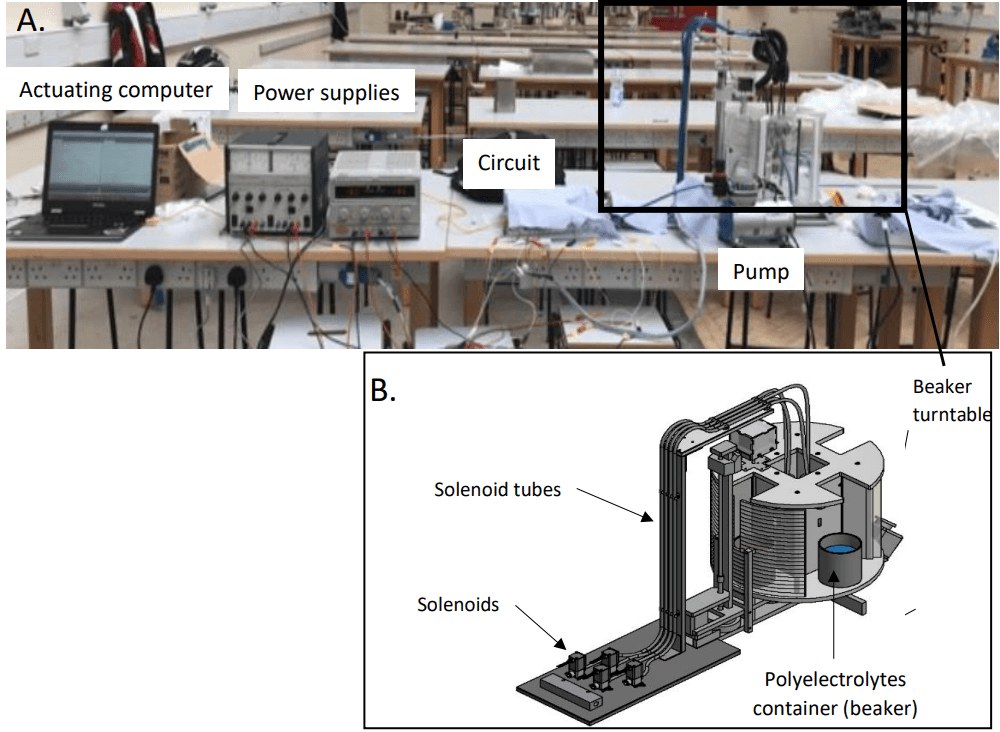
This was an eight-month-long team project that aimed to improve the marketability and performance of a previously designed Layer-by-Layer coating machine by improving the speed, reliability, and size of the electronic circuit dipping arm, and the functionality of the code. This was a multi-stage project involving problem definition, mechanical and electronics design.
🚨 Defining the Problem
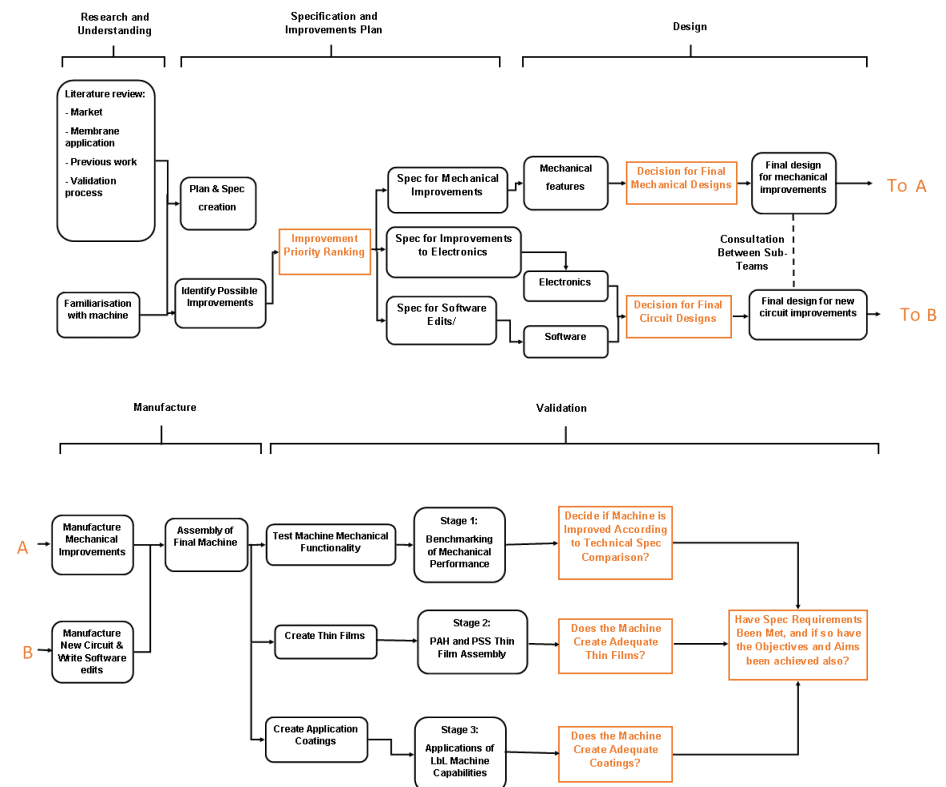
This project began with a literature review and product analysis to determine which parts of the design needed to be improved. This resulted in the following proposed improvements:
- Produce a functional Layer-by-Layer spray & dip coating machine.
- An integrated electronic system, run by a program capable of creating infinite layer numbers with an intuitive user interface.
- Technical performance data and thin-film testing data that demonstrates a more efficient mechanical function and a comparable coating quality to the previous machine iteration.
🔬 Approach to the Solution
Since this was a team project, the responsibility for each optimisation was distributed to the team members, according to our project plan. The optimization process involved:
- Redesigning the mechanical assembly for better structural integrity
- Developing a custom PCB to stabilize electrical connections
- Enhancing the control software for improved motion accuracy
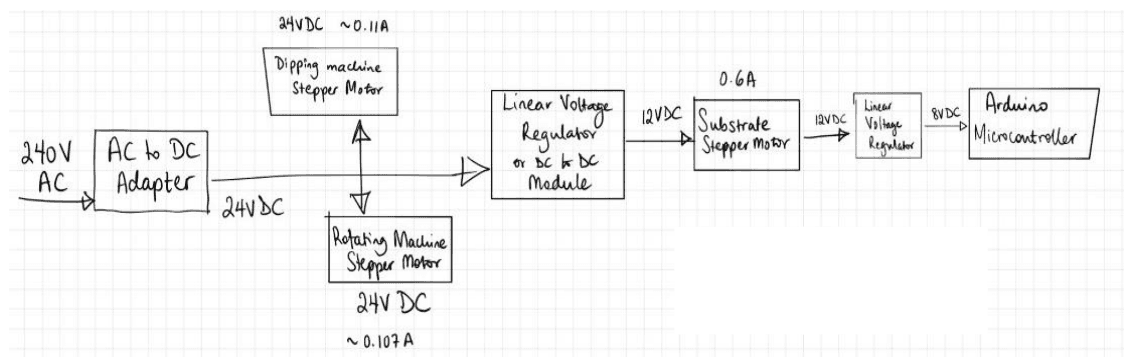
I was responsible for designing a new power circuit and converting the electronics systems from a breadboard into a printed circuit board (PCB).
🔧 PCB Development
The circuit board development went through four major stages: initial sketching, organizing components, breadboard testing, and final PCB assembly.
🔑 Key Changes
- The vulnerable breadboard circuit that relied upon multiple power sources was changed to a more robust printed circuit board (PCB) with a single mains power supply.
- The selection of a number of layers and coating method is now managed using a button-operated liquid crystal display (LCD), coupled with an integrated Arduino program.
- The speed of the dipping arm was increased from 66 mm/min to 319 mm/min by implementing a low-cost solution—utilizing the existing gears but rearranging them to improve the gear ratio.
- The revised machine setup resulted in 10 times less desk space being required for operation.
The process of validation was carried out by testing the machine's mechanical performance, through the creation of PAH/PSS thin films, and by the creation of antibacterial and oxygen barrier coatings.
Only one round of FTIR-ATR testing was completed, due to lab closures caused by COVID-19.
⚠️ Project Limitations
While the system was significantly improved, there were some limitations:
- Induced time constraints due to the COVID-19 Pandemic
- Lack of spray diversity from the nozzles, despite market preferences
- Inefficient use of space due to limited budget scope for component replacement
- Misalignment of gears due to motor resolution