🦵 Hydrogels for Cartilage Replacement
📖 About
This was a six-month-long individual project that aimed to synthesize an injectable or 3D printed polymerthat could replace cartilage lost due to osteoarthritis. This was a multi-stage project involving problem definition, materials synthesis and testing.
I acted as the primary researcher, experimental designer, and materials tester.
📊 Desired Material Properties
| Property | Required Numerical Range | Biological Rationale |
|---|---|---|
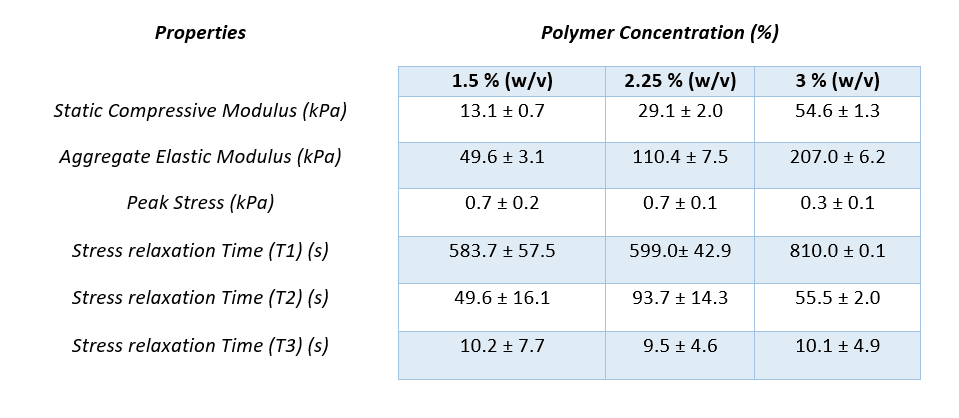
| Static Compressive Young’s Modulus (ES) | 570 ± 170 kPa (Bovine Patellar Cartilage) | Resilience to compressive static loading like that of healthy cartilage. |
| Aggregate Elastic Modulus (HA) – Compressive Strength | 300kPa to 660 ± 190 kPa (Bovine and Canine Patellar Model) | Resilience to compressive dynamic loading like that of healthy cartilage. |
| Porosity | 80% to 95% (Porcine chondrocyte model) | Allows chondrocyte migration and nutrient migration around the scaffold. |
| Pore Size | 70µm to 120µm (Porcine chondrocyte) | Allows chondrogenesis and extracellular matrix production. |
| Relaxation Time | 10.36 ± 5.91 s (Horse model) | Time taken for stress to drop to stress-relaxation limit, to measure how hydrogel responds in dynamic loads. |
| Hydraulic Permeability | Up to 2500% after 24h (Human Model) | Rate of movement of nutrients to and from the embedded chondrocytes. |
| Cytotoxicity | 50% viability of cells | Should not induce a destructive immune response in destined tissue. |
| Sol-Gel Transition Time | 20 to 30 minutes | Fluid state in a syringe and solidified in situ. |
| Sol-Gel Transition Temperature | 25°C to 38°C | Fluid state in a syringe and solidified in situ. |
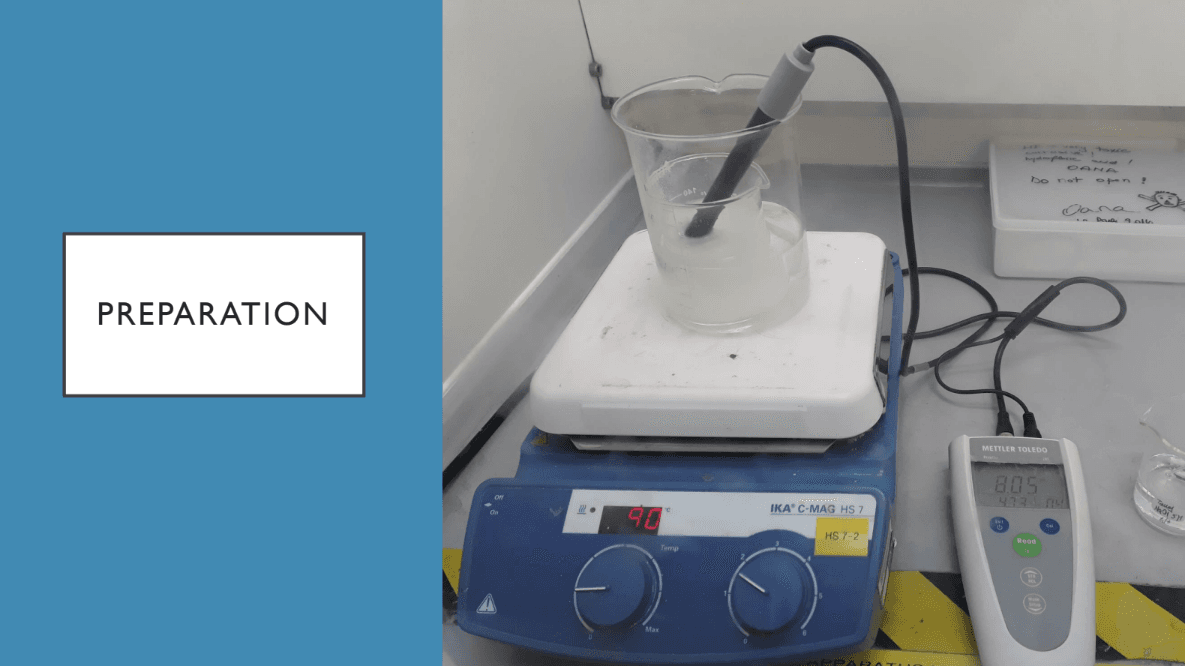
🏭 Manufacturing Process
🔬 Characterisation Results
📌 Conclusion
The 1.5 % (w/v) had the most appropriate mechanical and biomedical properties, but it did not survive rheology testing. It liquefies at 35.5°C, long before the human body temperature of 37°C. Further study is needed to ensure the polymer is injectable and survives in the human body.